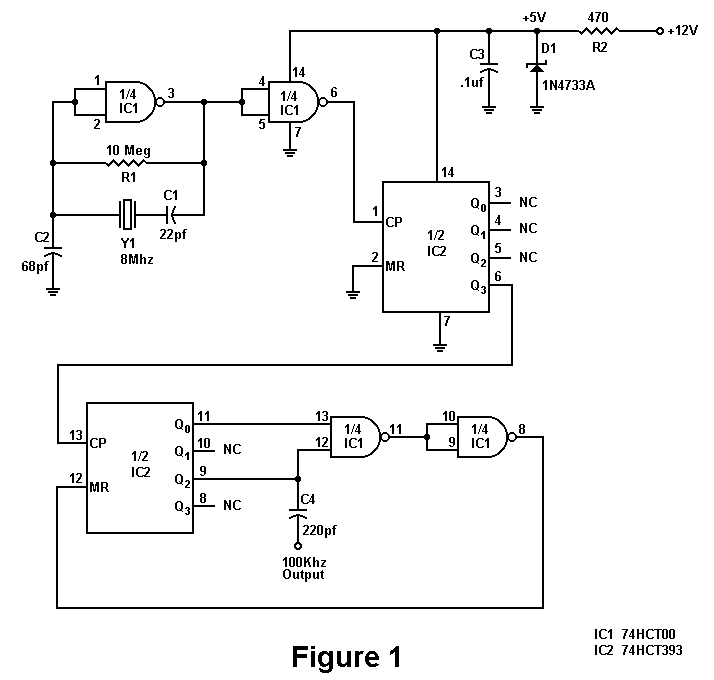
The most commonly used circuit is the colpitts circuit.
Ceramic resonator clock circuit.
The operating principle of these oscillation circuits can be seen in fig 2 1.
In a ceramic resonator oscillator the inductor is replaced by a ceramic resonator taking advantage of the fact that the resonator becomes inductive between resonant and anti resonant frequencies.
5 discount for the first 40 to order on jlcpcb with code jlcpcbnoob learn how crystal and ceramic resonators work.
Similar to the crystal oscillator ceramic resonator is also an electronic circuit or a device used to generate an output of oscillation frequency with the help of ceramic as a resonating piezoelectric material.
Although the basic configuration of the circuit is the same as that of a crystal controlled oscillator the difference in mechanical q results from a difference in circuit constants.
The material can have two or more electrode which when connected to an oscillator circuit gets mechanical vibration as a result an oscillating signal of a specific frequency is generated.
Power up the circuit with a clean 3 v to 5 v dc supply i e with a single li ion battery is.
A crystal oscillator is an electronic oscillator circuit that uses a piezoelectric resonator a crystal as its frequency determining element.
Also what kind of osciallator circuits.
A ceramic resonator is often used in place of quartz crystals as a reference clock or signal generator in electronic circuitry due to its low cost and smaller size.
Crystal is the common term used in electronics for the frequency determining component a wafer of quartz crystal or ceramic with electrodes connected to it.
They cost less and so are used where stability isn t as important.
The design of the circuit varies with the application and the ic to be used etc.
The lower q and higher frequency range achievable can be beneficial in use of tcxos temperature compensated crystal oscillators.
The most commonly used circuit is the colpitts circuit.
They do not hold their frequency as well.
For stable operation in such a design the phase shift compensation and gain control are provided by additional capacitors and resistors.
You can also replace the 10 7 mhz ceramic resonator with any other between 2 3 mhz to 26 mhz range.
The most common oscillator circuit for a ceramic resonator is a colpitts circuit.
In a ceramic resonator oscillator the inductor is replaced by a ceramic resonator taking advantage of the fact that the resonator becomes inductive between resonant and anti resonant frequencies.
Crystal and ceramic resonator based oscillators are most often implemented as pierce oscillators in which the crystal or resonator serves as a tuned element in the feedback of an inverting amplifier.
This may not be important for a microprocessor but will be important if the circuit is used in a radio a clock or other timing critical applications.